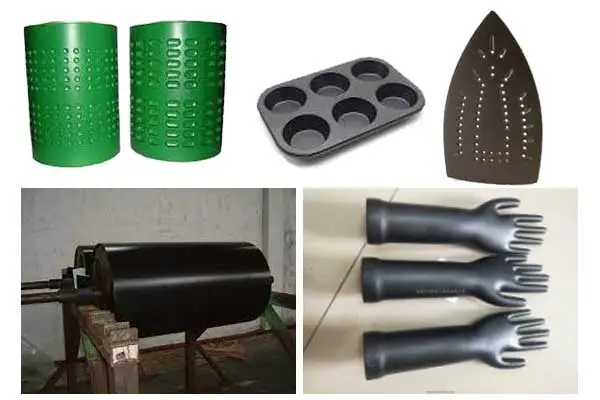
Non-Stick Ptfe Coatings
Non-Stick
Very few solid substances
will permanently adhere
to a “P.T.F.E” coating. And
while tacky materials may
show some adhesion, almost
all substances release easily
Heat-Resistance
There is no decomposition
of TFE finishes below 200’C.
insignificant decomposition
between 200’C and 260’C
which requires no special
precautions. Between 260’C
and 300’C, intermittent service
is possible with adequate
ventilation.
Cryogenic Stability
Many “P.T.F.E” coatings
will withstand severe
temperature extremes
without loss of physical
properties. “P.T.F.E” may
be considered for use at
temperature as low as -270’C.
Chemical Resistance
“P.T.F.E” is normaly
unaffected by chemical
environments. However,
certain coatings are
permeable or have a
lower resistance to attack
The only chemicals
known to affect all
“P.T.F.E” finishes are the
alkali metals and highly
reactive fluorinating agents.
Non-Wetting
Since “P.T.F.E” surfaces
are both oleophobic and
hydrophobic, they are not
readily wet. Clean-up is
easier, more thorough
and in many cases
self-cleaning
Low Coefficient of
Friction
The coefficient of friction
of “P.T.F.E” is generally in
the range of 0.05 to 0.20,
depending on the load,
sliding speed and
particular “P.T.F.E” finish
used.
Unique Electrical Properties
Over a wide range of
frequencies, “P.T.F.E.” has
high dielectric strength, a
low dissipation factor
and very high surface
resistivity. By special
techniques, it can even
be made conductive
enough to be used as an